

Measles!: Straight Talk from Kryssie Woods, M.D.
We are fortunate to live in a time & place where we don’t know what a lot of vaccine-preventable diseases (like measles) actually look like. We are also blissfully unaware of the severe disabilities that are often consequences of those illnesses. Before the recent news reports about measles, if someone stopped you on the street to ask what the symptoms of measles are, no doubt you’d stare blankly at them. On the other hand, if you were to call your grandparents, an elderly relative or possibly your parents (if they are over 51), they’d be able to tell you in detail. Chances are they had it during their childhood or in their teens. They also may have been related to, or knew someone who had serious complications, or sadly, someone who died of it.
Before the 1960s in the US, about 3-4 million people were infected with measles annually, of which 400-500 died. Each year, over 155,000 may have been “lucky” enough to have survived but suffered serious complications, such as pneumonia or brain swelling, which often resulted in deafness or devastating lifelong physical disability. A vaccine was introduced in 1963 and thanks to a highly effective vaccination program, measles was eliminated from the USA in 2000. This meant no cases of measles originated here as of 2000. Though, of course, some cases have been imported by travelers since then – both US citizens going abroad and foreigners visiting the US.
 What is striking about measles is how highly contagious it is. Remember all the panic with Ebola? The crazy quarantines. The airport “physicals” complete with taking peoples’ temperatures. The specialized medical equipment needed to transport Ebola patients. Well, measles is 9 times more contagious. One person with measles will go on to infect 12-15 susceptible individuals. If you were to put any number of non-vaccinated people into a room with a measles patient, 90% of them would get sick. It is an airborne disease that can remain in the air and on surfaces for two hours so it is possible to get measles without coming into actual contact with someone who is sick. It would be enough just to sit in the same room as they did, up to two hours after they’ve left! When someone is infected with measles, they become contagious 4 days before they even begin to feel sick. Often, they go about their usual day spreading the illness without even knowing they have it. Once symptoms do appear – fever, runny nose, cough, “pink eye” and a red, full body rash – they remain contagious for 4 days.
 The most recent measles outbreak, which originated in Disneyland, California in late 2014, has brought this disease and discussion about prevention into the forefront of personal and political debates. And with good reason. Last year’s measles outbreak in the USA is the largest in the last 20 years, totaling 644 cases. We are now only into the second month of 2015 and already there are over 141 reported cases. Last week, New Jersey became the 17th state with a case of measles, reported in Jersey City. With that news literally at my doorstep, friends, family, and patients have been calling for advice on what to do to keep themselves and their families safe.
While it is hard to generalize, here is what the Centers for Disease Control (CDC) and the American Academy of Pediatrics (AAP) recommend. Of course, there are exceptions to these recommendations, so it is important that you consult your doctor or your child’s pediatrician with any questions.
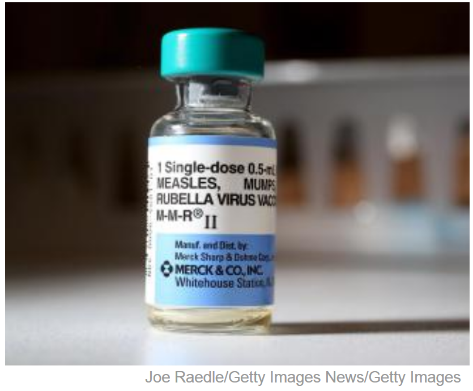
 Vaccinate! Yes, I said it. And have therefore dragged myself into a large debate on the topic. But from the standpoint of sound medical evidence, there is no debate. The current recommendations for vaccination are 1 dose of MMR (measles, mumps, rubella vaccine) sometime between 12-15 months and a 2nd dose (“booster”) between 4-6 years of age. The reason for the 2 doses is to raise immunity to 97%…as opposed to 93% with just 1 dose. Children & adults who have immune disorders or a weak immune system because of certain medications, HIV, cancer, severe gelatin allergies, and pregnant women can’t be vaccinated. Aside from anyone who fits into one of these categories, there is no good reason not to vaccinate. Of course it is really unpleasant to have to sit and hold my son down while his pediatrician gives him vaccines. I hate it. But it would be far more unpleasant for him to get seriously sick and for me to know that it could have been prevented.
Tons of studies have been done on the safety of the MMR vaccine (and other vaccines!) yet there are still people who believe the vaccine might cause autism. That would be thanks to “research” done by Andrew Wakefield that was printed in 1998 in the Lancet, a British medical journal, claiming a link between MMR and autism. In 2010, it was proven that Wakefield, driven by financial gains, had falsified his data. The journal immediately printed a retraction, and Wakefield lost his medical license. But, unfortunately, the damage was done. Evidence of this was an approximate 10% decline in vaccination rates in the USA, UK, and Ireland causing a subsequent rise of measles & mumps cases. There was then a knock-on effect, with the necessity for and safety of other vaccines coming into question by anti-vaccine groups.
What has made the anti-vaccine movement stronger, despite the total lack of evidence that it causes autism, is that we still don’t know what causes autism. For some time, there was a thought that a vaccine preservative called Thimerosal, might be causing the increase in autism rates. Another popular argument is that the “vaccine antigen load” is too high and leads to autism because of an over-stimulation of the immune system. Multiple studies have examined both of these claims and have concluded that no link exists between Thimerosal and autism or vaccine load and autism. Since 2001, childhood vaccines no longer contain Thimerosal, and yet the diagnosis of autism is on the rise. And as for antigen load? In the 1980s, vaccinated individuals received about 3,000 antigens cumulatively via immunizations, whereas today it is only 150 antigens. Despite the decrease of antigen load, autism cases have also continued to increase. Without a solid explanation for the cause of autism, the anti-vaccine movement will undoubtedly continue. And, unfortunately, these claims will attempt to be passed off as sound science.
Is MMR safe? Of course, there is nothing that we ingest or inject that is 100% safe. And it is true that all vaccines come with side effects. The chance of a serious side effect from the MMR vaccine is 1 in 40,000 compared with a 1 in 20 chance of a life-threatening measles-related pneumonia or 1 in 1,000 chance of severe neurological disability or death from measles. Your child has a better chance of being injured in a car accident than he/she has of having a serious vaccine side effect. When you look at these numbers, the benefits outweigh any potential risks.
So yes, vaccinate! If you or any other adult aren’t sure if you’ve been vaccinated, the CDC recommends that you see your doctor and get the MMR vaccine. Worst case scenario, you’ve gotten 3 in your lifetime as opposed to 2.
If you are planning to travel abroad with a baby who is between 6-12 months, the CDC currently recommends getting him/her vaccinated before your trip. Why? Because measles is very common outside the US, and not just in developing countries. In 2014 there were 3,840 cases in Europe, down from over 10,000 in the previous year. MMR is not routinely recommended for children under 1 because there won’t be lasting immunity from the vaccine, but the recommendation exists to protect your child for the duration of your trip. When you’re back home, your baby will still need the usual MMR doses at 12-15 months and again between 4-6 years of age.
If you are pregnant, you will have to wait until AFTER you deliver to get your vaccine. That’s because of a potential risk to the fetus from the vaccine. If you’re breastfeeding, rest assured that MMR is safe to get while breastfeeding. And if you’re already planning for that next baby, you’ll have to wait at least a month after your get the MMR before you get pregnant.
 Need another good reason to vaccinate? Think of it as a matter of social responsibility. You and your vaccinated child aren’t the only ones who are getting protection from measles. By being vaccinated, you’re also protecting those around you who cannot get vaccinated – your pregnant friends, your youngest family members (those under 1) and your neighbor whose child is recovering from leukemia. This is the concept of “herd” immunity. In order for those vulnerable members of our community to remain safe, we need to immunize about 93-94% of the population. The lack of herd immunity in several areas of the country will continue to fuel the current measles outbreak.
 There has been a lot of discussion in the political and legal spheres about vaccination. There is no uniform law governing the ability to opt-out of immunizations. Each state, not the federal government, decides what options its citizens have. Many state legislators are now looking at the laws and have started putting forth bills to bring an end to the ability to opt-out for personal and religious beliefs. This is because measles is now affecting not only those who have chosen to not vaccinate, but also those who cannot be vaccinated. The argument is that this is an issue of public safety, no different than drunk driving, seat-belt, or car seat laws.
Thankfully there have been no deaths because of the current outbreak. Many in the medical community, myself included, strongly believe that religious and personal exemptions to vaccines need to be eliminated. I share the concern of many of my colleagues that it may take a fatality to highlight that measles isn’t a disease to be taken lightly. I sincerely hope it doesn’t come to that.

Kryssie Woods, M.D.
Kryssie Woods is a board certified internist and infectious disease specialist. She completed her Internal Medicine internship and residency in New York Hospital Queens. She then completed a fellowship in Infectious Diseases at Mt. Sinai’s Beth Israel campus in Manhattan, where she served as one of two chiefs in her final year.
Kryssie’s specific interests within medicine include travel medicine, public health, virology (in particular herpes & influenza), medical ethics, antibiotic misuse/overuse and bacterial resistance (“superbugs”).
She has spoken in conferences for infectious disease specialists in New York City, presenting some notable cases in 2012 and 2013. Kryssie has published several articles on the topic of multidrug resistant bacteria. Her work on the effects of antibiotics on the development of bacterial resistance was presented in a national meeting on infectious diseases in San Francisco, in 2013.
Kryssie is currently affiliated with Carepoint Health and has opened her own infectious disease & travel medicine practice, Hudson Infectious Diseases, in Bayonne, New Jersey.
Outside of medicine, Kryssie and her husband are parents to a super cute and active 9-month old son. In the little spare time she has, she enjoys reading, cooking and traveling.
* The opinions expressed here do not necessarily represent those of Moxy & Main, LLC.